I rode the Shanghai Metro almost daily during my ten years in the city. For a first visit, you do not need to memorise the network. You need a way through the gate, the correct direction on the platform, and the right exit at the other end.
My default is simple: tap an eligible contactless bank card, use a route planner for each journey, and check the last train before dinner if you will be out late. Buy a pass only if your plans involve a lot of metro rides.
Shanghai Metro: the short answer
| Question | My advice |
|---|---|
| How do I pay? | Tap an eligible contactless bank card, or use a transit QR code you have already set up. |
| How much is a ride? | The published base fare is ¥3; the fare rises with distance. |
| Which line links the airports and centre? | Line 2 serves Hongqiao Terminal 2, People’s Square and Pudong Airport. |
| When is the last train? | Check your station, direction and connecting line. There is no network-wide closing time. |
Every station has a security check before the gates. Leave a few extra minutes if you have luggage, and avoid the weekday commuter peaks if you can.
Shanghai Metro map (2025/2026): use a live route planner
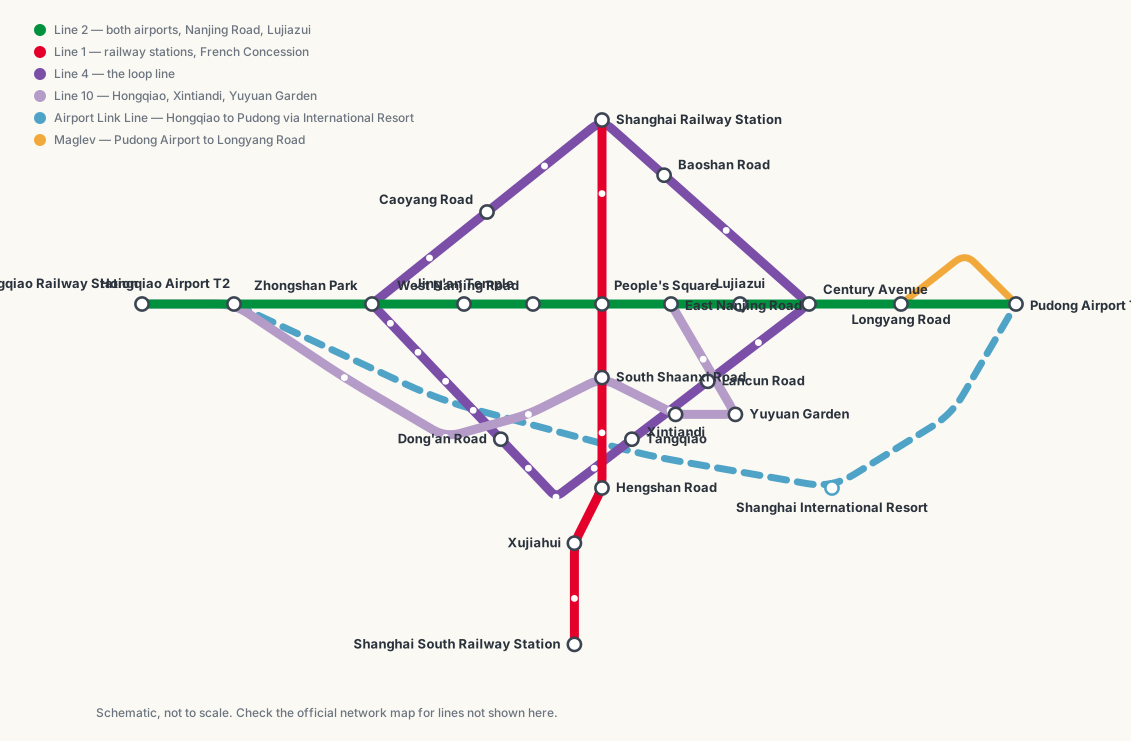
This is a visitor diagram, not the full Shanghai Metro map. It helps you place the airports, main railway stations and central stops. It does not show every line or every station. Do not use it to decide a precise transfer or travel time.
If you saved a map in 2025, check it again before your 2026 trip. Line 2 gained a western stop at Panxiang Road in late 2025, and the network has continued to grow. The English-language SH MaaS app shows routes and first and last trains; it is more useful on the move than a static screenshot.
The map habit that saves me the most time is checking the exit number before I arrive. At People’s Square or Century Avenue, the wrong exit can put you on the wrong side of a big junction or a long underground corridor.
Shanghai Metro Line 2: both airports, but not every terminal
Line 2 is the one most visitors use first. It crosses Shanghai from west to east and reaches several places you are likely to need:
| Line 2 stop | Why it matters |
|---|---|
| Hongqiao Railway Station / Hongqiao Airport Terminal 2 | High-speed trains and airport Terminal 2. Terminal 1 uses Line 10. |
| Jing’an Temple / People’s Square / East Nanjing Road | Central bases, shopping and a walk towards the Bund. |
| Lujiazui / Longyang Road | Pudong sights; change at Longyang Road for the Maglev. |
| Pudong Airport Terminal 1&2 | The inexpensive rail route to Pudong Airport. |
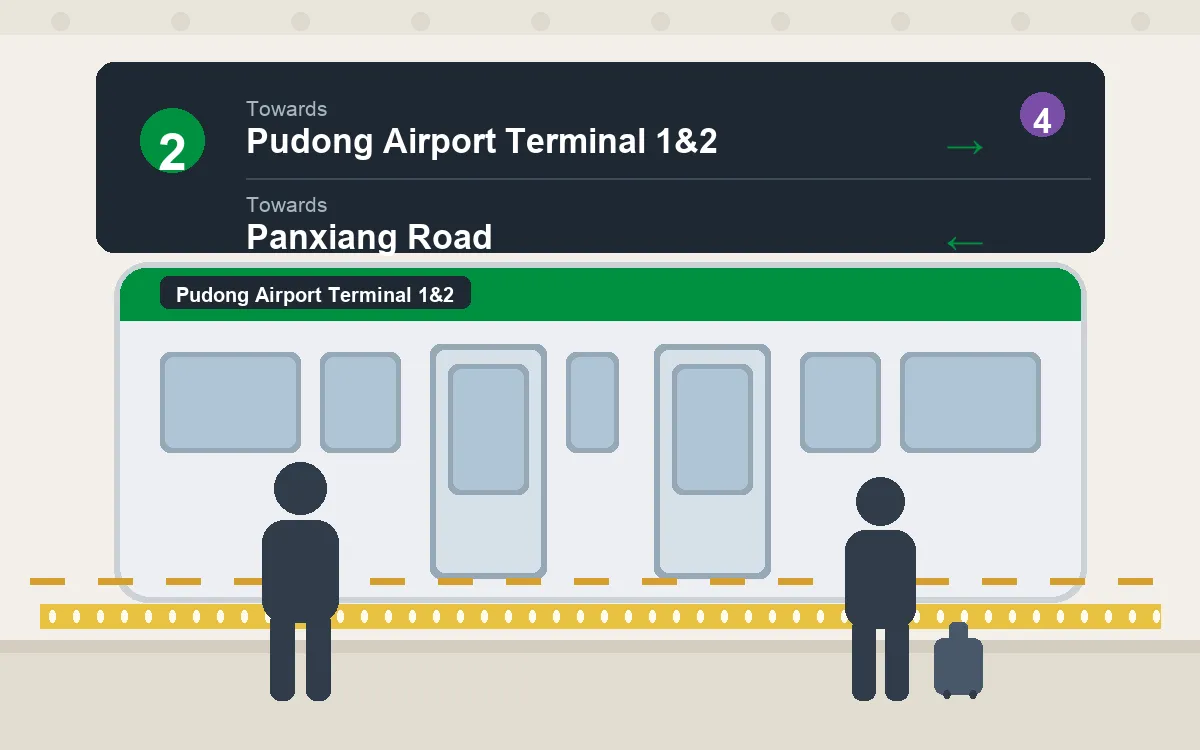
Line 2 has regular trains to Pudong Airport, so the old blanket advice to change at Guanglan Road is out of date. Still, do not board on line colour alone: some services terminate before the end of the line. Read the destination on the platform display, especially late in the evening.
If you are arriving at Pudong, Line 2 is the cheapest straightforward option, but it is not always the best one with heavy luggage or a late flight. Compare it with the Maglev, Airport Link Line and a car using the city’s airport transport overview. The Airport Link has separate fares and gates; it is not simply another metro train covered by a metro pass.
A Line 2 toilet tip: Friends and I have spent too long looking for a WC on this route. Do not assume the next stop has one: at some stations it is inside the paid area, at others it is outside the gates, and some have no station toilet. Before tapping out, check the signs or ask staff where the nearest usable one is.
Shanghai Metro tickets and prices: pay for the rides you take
The city’s current metro guide lists ¥3 for the first 6 km, then ¥1 for every additional 10 km on ordinary metro lines. The system charges by distance, not by the number of lines you use. Most central sightseeing rides cost only a few yuan.
Shanghai proposed a fare revision in 2026. I would not build a budget around an old station-to-station fare table while that decision is pending. The fare shown in your route planner or at the station is the one to use.
Here is the payment choice I would make:
| Ticket or payment | Choose it when |
|---|---|
| Contactless bank card | You have an eligible UnionPay, Visa, Mastercard, Amex or JCB card. Tap the same card in and out. |
| Transit QR code | You already use Alipay, WeChat or SH MaaS and have the metro code ready. |
| Single-journey ticket | Your card or app does not work. Use a machine or ask at the service centre. |
Shanghai Metro says eligible contactless cards work at the gates across the network. Enable small-value contactless payments with your bank before you travel. If a card is declined, use the station service centre rather than repeatedly holding up the gate.
Single tickets are a practical backup, not a failure. Depending on the machine, you may receive a reusable IC ticket or a paper QR-code ticket; follow the instructions printed on it. Station service centres can take international bank cards for ticket purchases. For paying elsewhere in China, see my foreign-card and mobile-payment guide.
Shanghai Metro card or pass: is unlimited travel worth it?
For most short stays, no separate transport card is needed if your bank card or transit QR code works. A physical Shanghai Public Transportation Card can be useful for a longer stay, but I would not buy one just to make two or three sightseeing trips.
The ordinary metro one-day pass is ¥18 for 24 hours from first entry; the three-day pass is ¥45 for 72 hours. They allow unlimited eligible metro rides during operating hours. Neither covers the Maglev or suburban rail services opened in or after 2024, including the Airport Link Line. Those are different products from the multipurpose Shanghai Pass and the passes sold in SH MaaS.
I would add up the rides I actually expect to take before buying a pass. If you plan to walk between nearby neighbourhoods and use the metro two or three times a day, ordinary fares are usually simpler. If you are crossing town repeatedly, ask at the ticket booth for the metro one-day or three-day pass so you do not buy a similarly named product by mistake. Prices and exclusions are listed in the official ticket guide.
Shanghai Metro hours: check the last useful train
There is no single “Shanghai Metro closing time.” The first and last departure depends on the line, station, direction and day. Friday, Saturday, holiday and event services can also differ from an ordinary weekday.
Before a late dinner, open the SH MaaS timetable and route planner or check the last-train board at the station. If you need to change lines, check the last departure on the second line, not only the train you board first. Extra late trains do not always offer normal transfers.
I would not use a years-old PDF or a generic “trains run until 11 pm” rule to plan an airport trip. If the last useful train has gone, take a taxi or ride-hail rather than improvising a complicated route with luggage.
How to ride the Shanghai Metro without second-guessing every sign
- Search your destination and note the exit. A map app will give you the line, transfer and nearest exit. Station names are signposted in English.
- Go through security. Bags are screened before the fare gates; keep your card or QR code ready afterwards.
- Tap or scan in. Use the same payment method when you leave. For a single ticket, follow the gate’s instructions at the exit.
- Choose the direction by destination. Signs usually name the station the train is heading towards, not “northbound” or “southbound.” Check the platform display before boarding.
- Follow transfer signs inside the paid area. Most changes need no second ticket. At a few out-of-station transfers, you must leave one station box and enter another; follow the signs and check the rules for your payment method.
Two quirks are worth knowing. Lines 3 and 4 share a platform along part of their route, so check the number on the arriving train. Line 4 is a loop; look at the next stops on the platform display instead of trying to work out “clockwise” under pressure. I have taken it the wrong way myself.
The costly mix-up is often above ground: Shanghai Railway Station and Shanghai Hongqiao Railway Station are not the same place. Check the station on your high-speed rail ticket before you book a hotel or leave for a train. My China train guide explains the wider rail system, and my Hangzhou-versus-Suzhou guide helps you choose a day trip from Shanghai.
My advice for a first Shanghai trip
Use the metro for the long hop, then walk the neighbourhood. You do not need to change lines twice to save a ten-minute walk. With luggage, a tired parent or a late arrival, paying for a car can be the better decision even when the metro is cheaper.
Once your transport is sorted, start with Shanghai’s main destination page and the experiences I would prioritise on a first visit.