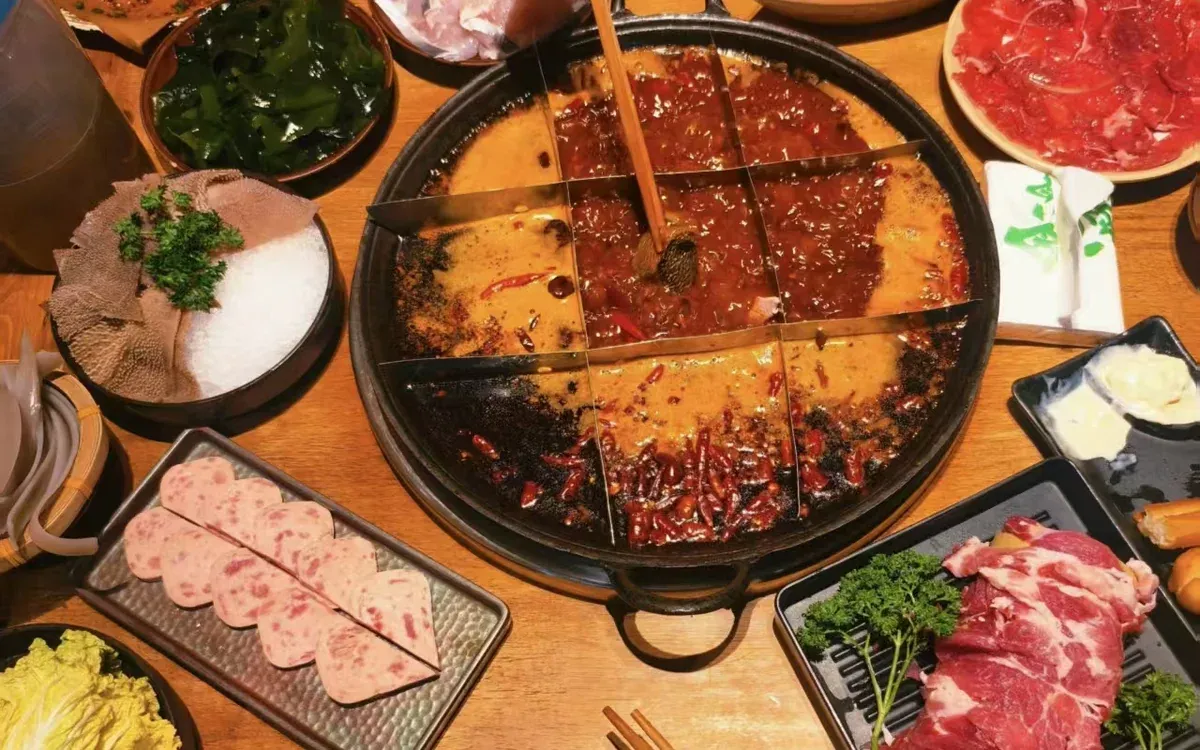
A hotpot dinner in Chongqing costs ¥80 to ¥135 per person all-in, from about ¥60 at a neighbourhood place to ¥105–140 at a Nanshan hillside restaurant.
Two line items surprise people. The soup base is charged per pot, usually ¥38 to ¥68. The dip is charged per person, ¥4 to ¥8.
Wei la, the mildest heat setting most places offer, is still properly hot. Locals will tell you it is what other Chinese cities call medium, so order it and do not talk yourself into anything hotter.
And the first dish to order is fresh beef tripe, which cooks in about fifteen seconds and tells you most of what you need to know about the kitchen.
The short answer
| The question | The answer |
|---|---|
| What dinner costs | ¥80–135 per person all-in, base and dip included, before drinks |
| How hot it really is | wei la is still properly hot; a yuan yang split pot if unsure |
| What to order first | fresh tripe, duck intestine, aorta, one beef plate |
| Which area | Jiefangbei for convenience, Nanshan for the spectacle, neighbourhood places for the real thing |
| When to go | 11:30 lunch, or after 20:00; 18:00–19:30 is the queue |
| How long it takes | about two hours, and nobody rushes you |
What makes Chongqing hotpot different
The base is beef tallow, not oil. It arrives as a red block that melts into a thick, glossy pool, and it sets solid again on your plate once it cools.
The seasoning underneath is short: dried chilli, Sichuan pepper, fermented broad bean paste, a little ginger and garlic. That is close to the whole list, which is why the numbing arrives before the heat does.
It is also a serious industry. Chongqing has around 40,000 hotpot restaurants, and about 160,000 of China’s 500,000 hotpot spots trace their lineage back here, according to China Daily. The city was named China’s hotpot capital by the China Cuisine Association on 19 March 2007.
Nine squares, and why they are not a menu
The grid is a heat map, not a portioning system. The centre boils hardest, so it is for anything that cooks in seconds. The side squares run cooler, for things that need a couple of minutes. The four corners are gentlest, and that is where potato, lotus root and duck blood go to sit.
The origins are usually told this way. In the 19th century, porters along the river cooked offal in chilli because it was cheap and the fat kept them warm. Vendors sold it from a shoulder pole with a divided tin basin on top, and each customer claimed one compartment and paid by the piece.
That is said to be the ancestor of the nine-grid pot, which is why the squares still feel like territory rather than temperature zones.
Best Chongqing hotpot restaurants, by area
Four kinds of evening cover almost every trip. I have grouped them by what the evening is for rather than by ranking, because the right answer depends on whether you want convenience, a view, a room full of locals, or a spectacle.
Chinese names to paste into Amap
Search engines here match Chinese characters, not pinyin. Copy these strings.
| Place | Chinese name | Area | Per person |
|---|---|---|---|
| Peijie | 珮姐老火锅 | Minzu Road, near Hongyadong | ¥100–125 |
| Zhou Shixiong | 周师兄大刀腰片老火锅 | Minsheng Road, Jiaochangkou | ¥95–130 |
| Deng Mangzi | 邓莽子老火锅 | Zhongxing Road, Jiaochangkou | ¥75–85 |
| Pipa Garden | 枇杷园食为鲜火锅 | Nanshan, Jinzhu village | ¥110–130 |
| Xian Longjing | 鲜龙井火锅公园 | Nanshan, Huangjueya | ¥110–140 |
| Badadotang | 巴倒烫陆派火锅 | Nanshan, the same stretch | ¥105–115 |
| Yuzong | 渝宗老灶火锅 | Huangnibang, Jiangbei | ¥80–100 |
| Xiaoyu | 渝味晓宇火锅 | Pipashan Street, Yuzhong | ¥80–110 |
| Underground City | 地下之城·防空洞老火锅 | Longtousi, Liangjiang | ¥60–90 |
Deng Mangzi and Zhou Shixiong are close to Jiaochangkou station (lines 1 and 2), and the Hongyadong side of Jiefangbei is close to Xiaoshizi (lines 1 and 6). Everything else is a taxi, which in this city is cheap and usually faster than the walk looks on a map.
Jiefangbei and Hongyadong
This is where you end up on the first night, and it is the easiest place to eat well without planning.
Peijie is the name everyone will give you, and it is a reasonable first hotpot: nine-grid pots and a base with real depth. Expect a queue at dinner and a loud room.
Zhou Shixiong is on the next block and calmer. Its signature is big, thin-sliced kidney, a gentler first organ than it sounds, plus fresh tripe.
Deng Mangzi on Zhongxing Road is the one for the older version of this meal. It has been going since 1996, the room is plain, the base is heavy, and the squid and pork loin are what people come back for.
Nanshan, the hill of restaurants
Nanshan is a mountain on the south bank where the restaurants are the size of villages. People go for the setting as much as the food, and it is a taxi ride, not a metro stop.
Pipa Garden is the one that gets photographed: nearly 700 tables terraced up a hillside, and a Guinness record for the largest hotpot restaurant by seat capacity, certified at 5,851 seats in July 2022. It runs ¥110 to ¥130 a head, opens at 09:00 and stays open past midnight.
Xian Longjing is the lotus-pond version, with tables on platforms over water and a premium tripe at ¥228 per jin. Badadotang, on the same stretch of hill road, is the forest one, at ¥105 to ¥115.
Go at dusk, book or arrive before 18:00, and treat the meal as the evening rather than a stop inside one.
Neighbourhood old-style places
These are what locals mean by old hotpot: plainer rooms, lower prices, and spread across the city rather than clustered in one district.
Yuzong started in 2008 and now has branches across Chongqing; the Huangnibang original is the one to aim for. It serves shui ba kuai, the old name for the riverbank hotpot, made of pre-braised tripe, heart, tongue and intestine. About ¥80 to ¥100 a head.
Xiaoyu sits up on Pipashan in a converted residential building, low stools and all, and became famous after appearing in A Bite of China in 2014. Its base is chilli, pepper, tallow and bean paste with little else, and the rice-field tripe is the order. Roughly ¥80 to ¥110.
The spectacle: dinner in an air-raid tunnel
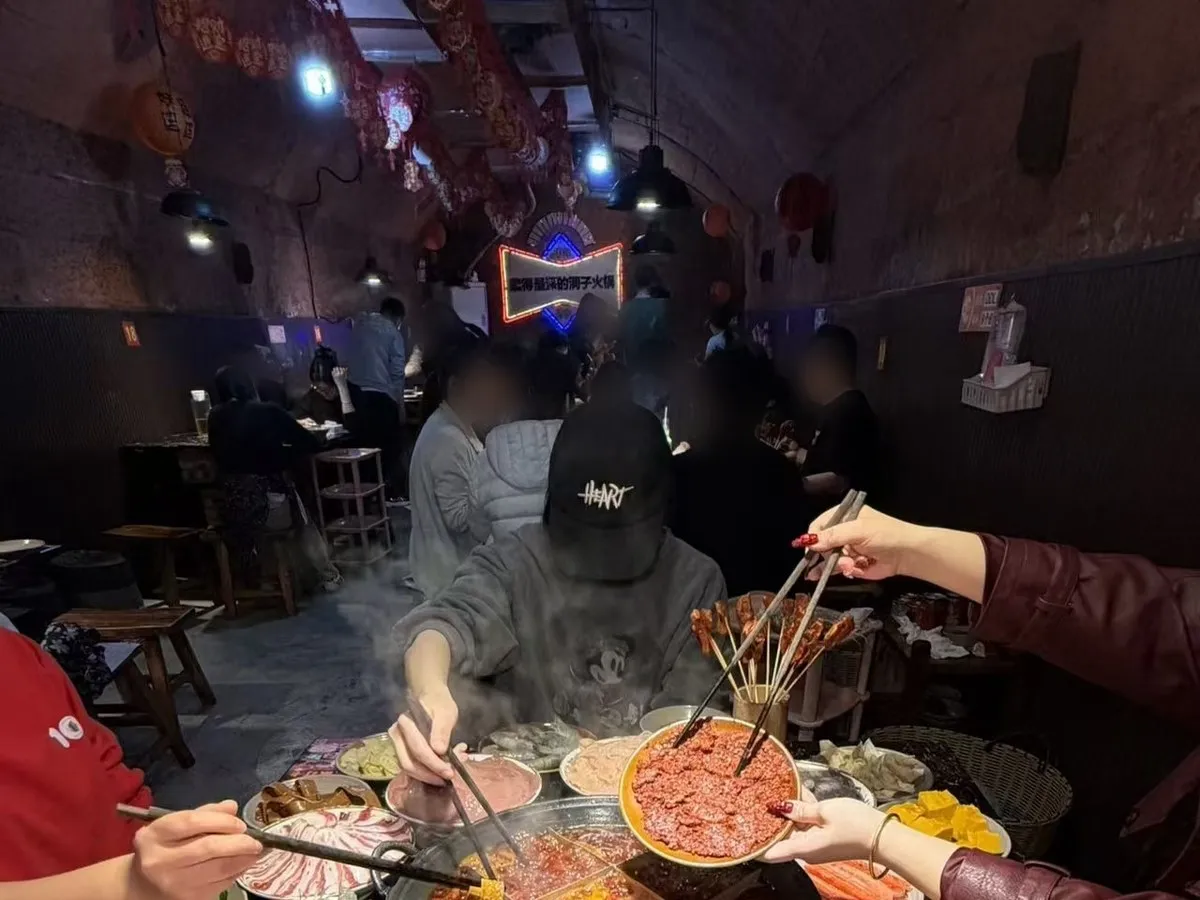
The Underground City hotpot is a first-timer pick for reasons that are not really about the food. It occupies a civil-defence tunnel built in the 1970s and later converted into a dining room: about 520 metres of corridor, 4,500 square metres, 218 tables and room for well over a thousand people.
The rock holds it at a steady 25 degrees, which is why it makes sense in August. It runs 24 hours, the plates are small bowls so you can try a dozen things, and the guide listings put the average at ¥80 a head. A table of three came to ¥198 in one foreign visitor’s account.
Budget ¥60 to ¥90 if you order beef, shrimp paste and vegetables, and more if you go for the offal. It sits in Longtousi, near the south gate of Longtousi Park, a taxi ride from the peninsula rather than a walk from Hongyadong.
How much does hotpot cost in Chongqing?
All figures are per person, including base and dip but before drinks.
| Tier | Per person | What it buys |
|---|---|---|
| Neighbourhood old-style | ¥60–85 | plastic stools, no English, the base everyone rates |
| Mid-range, central | ¥95–135 | nine-grid pots, air-conditioning, Jiefangbei locations |
| Nanshan view | ¥105–140 | terraced or garden settings, the spectacle |
| Underground City | ¥60–90 | small bowls, a steady 25 degrees, a tunnel |
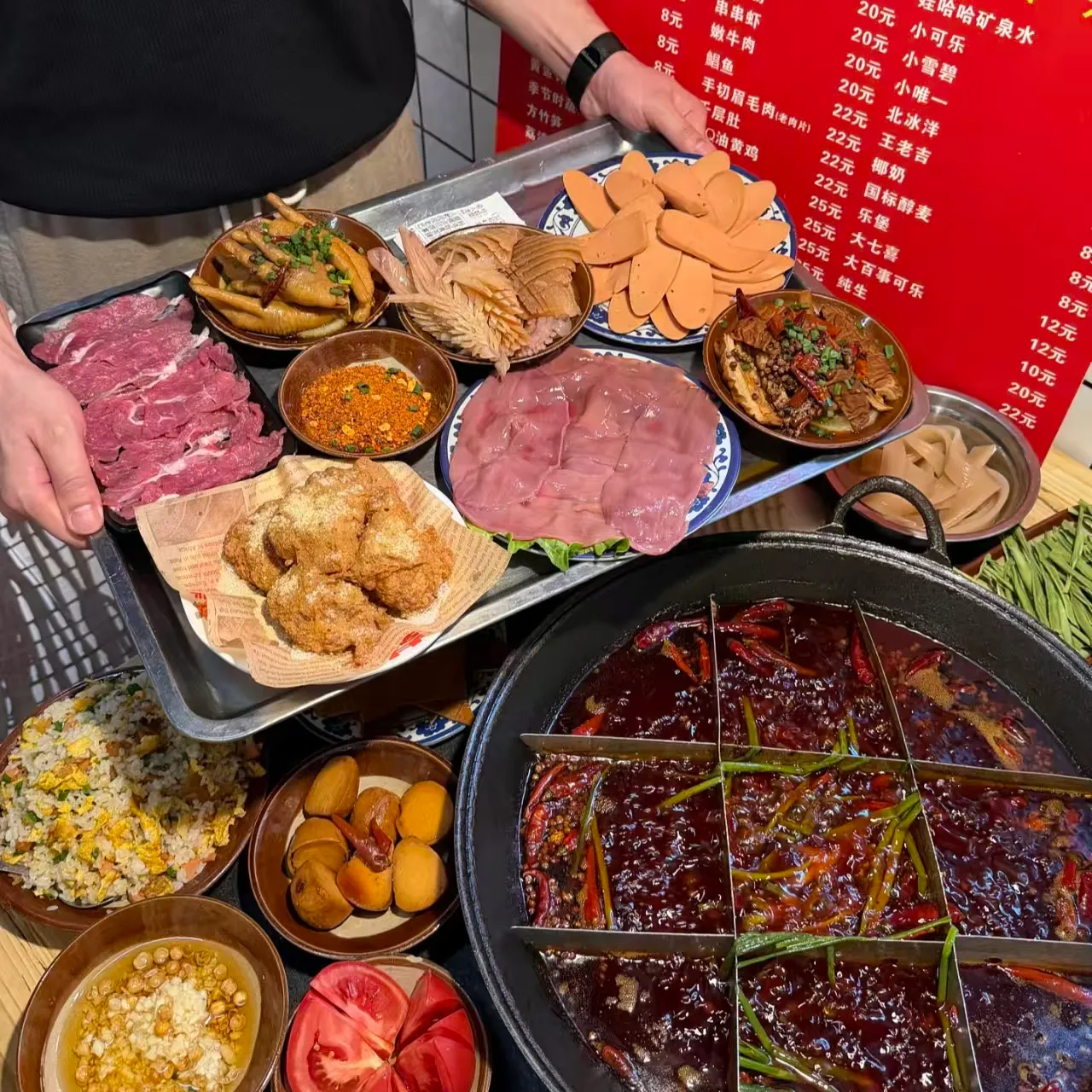
The ¥100-ish averages you see on review sites come from people using group vouchers, ordering fewer plates, or drinking the free tea instead of anything else. None of that is wrong. It is just a different order.
Charges that review-site averages hide
- The base, ¥38–68 a pot. A separate line, charged per pot rather than per diner. A split pot usually adds about ¥10.
- The dip, ¥4–8 per person. Sometimes called a sauce or seat fee, and usually it includes the self-serve sauce bar.
- Tissues and takeaway boxes. Sometimes on the table, sometimes added to the bill.
- Vouchers that exclude the base. A ¥128 set for two often means ¥128 of food, with the base on top. Read the small print.
Cheapest hotpot in Chongqing
The cheapest version of this meal is not a secret restaurant. It is a set of decisions.
Eat at lunch. The same pot, the same kitchen, a quieter room, and at some places a cheaper menu. Ask before you sit down rather than assuming.
Order small bowls. The tunnel restaurant runs more than 120 dishes as small plates, which lets two people try eight things without committing ¥40 to each. Elsewhere, ask whether they do half portions of vegetables.
Drink the free tea. Strong tea, usually a local herb brew, is poured without charge and is what most tables are actually drinking. The sweet soy milk everyone photographs costs money.
Skip the scenic postcode. The restaurants with a view of Hongyadong charge for the view. A few minutes inland, the same dishes cost less.
Time the queue instead of paying to avoid it. A taxi to a suburban branch to dodge a two-hour wait is often better value than a premium table at 19:00.
If even ¥60 a head feels like a lot, the honest alternatives are skewers in the same mala broth, billed per stick, and the city’s breakfast noodles, which run about ¥7 to ¥12 a bowl at a neighbourhood shop and are a better introduction to how Chongqing eats on a Tuesday.
How to order, step by step
Ordering is where the evening is won or lost, and almost none of it happens in spoken English. Get your payment app working before you sit down, because the QR code on the table will not wait for you.
In September 2026 the city published a bilingual food map with shop locations and dish notes, a reasonable second opinion if the queue at your first choice is two hours long.
- Get a number. Join the queue remotely through Dianping, or take the paper ticket the door staff hand you.
- Scan the code on the table. Ordering runs through WeChat or Alipay. If it will not load, ask for cai dan and someone will bring a paper menu or stand over your phone with you.
- Pick the pot. All-spicy, half and half, a big pot with a small mild one inside it, or three compartments. The last is what you want if one person in four does not eat chilli.
- Pick the heat. Mild, medium, hot. Some places now offer a notch below mild, and it is worth asking.
- Order the four. Tripe, duck intestine, aorta, one sliced beef. Then fried pork, duck blood, potato, lotus root, and the crunchy dried vegetable stems.
- Build the dip. Sesame oil, a heap of raw minced garlic, coriander, spring onion, a splash of vinegar. No soy sauce, no sesame paste.
- Cook in the right square, then top up. Dip tripe and intestine for about fifteen seconds, in and out rather than submerged. Cook beef until it loses its pink, and put starch in the corners, late. When the broth drops, ask for more rather than adding your own water.
- Pay at the counter. Check the base and the dip are on the bill before you do.
Ordering decoder
Show your phone to the staff, or point at the characters.
| Say or find | Characters | What it gets you |
|---|---|---|
| hong tang | 红汤 | all-spicy base |
| yuan yang | 鸳鸯锅 | half spicy, half mild |
| zi mu guo | 子母锅 | big spicy pot with a small mild one inside |
| ben chi guo | 奔驰锅 | three compartments, three broths |
| wei la | 微辣 | mild, which is still hot |
| wei wei la | 微微辣 | a notch below mild, where offered |
| mao du | 毛肚 | fresh beef tripe |
| ya chang | 鸭肠 | duck intestine |
| huang hou | 黄喉 | beef aorta |
| ya xue | 鸭血 | duck blood |
| xia hua | 虾滑 | shrimp paste |
| gong cai | 贡菜 | crunchy dried vegetable stems |
| nao hua | 脑花 | pork brain |
| su rou | 酥肉 | crispy fried pork |
| jia tang | 加汤 | add broth |
The organs you can skip
You do not have to eat any of this to have had Chongqing hotpot, but it helps to know what you are turning down.
Tripe is stomach lining, cut into sheets with a texture like soft rubber bands that snap. Aorta, sold as huang hou, is the great vessel off the heart and the crunchiest thing on the table.
Duck intestine is exactly what it says and cooks in about ten seconds. Pork brain, nao hua, is soft and rich in a way that divides even locals.
If none of that appeals, the safe order is sliced beef, shrimp paste, tofu, potato and fried pork. It is still a proper hotpot, and it costs less.
Chongqing hotpot etiquette
Do not reach across into someone else’s section. The pot is shared, but leaning over another diner’s side is the move that gets a look.
Scoop rather than stir. Stirring drags the chilli sediment up through the oil. Take from where you are.
The dip is for cooling, not for flavour. Drag the piece through the oil and eat. Do not drown it, and do not add soy.
Do not overcook the tripe. The pot will still be there in a minute, and the tripe will not be worth eating.
Put starch in late. Potato and noodles go into the corners at the end, not into the centre early.
Say thanks when someone tops up your tea. It happens constantly and it is the local form of hospitality.
Then the universal ones: use the serving chopsticks if a set is provided, do not put anything back in the pot once it has been in your mouth, and expect a polite fight over the bill, which is a script. The host usually wins.
Chongqing versus Chengdu
The shorthand is that Chongqing uses beef tallow and Chengdu uses oil, so Chongqing is heavier and Chengdu softer. That is broadly true and increasingly unreliable, because Chengdu now has plenty of tallow-forward old-style places of its own.
The difference that survives is seasoning. A Chongqing base is chilli, pepper, bean paste and not much else, so the numbing hits first and the heat follows. A Chengdu base usually carries more spices, sometimes fermented rice or rock sugar, and lands rounder.
The rest follows. Chengdu restaurants are likelier to have a round pot and a sauce bar with sesame paste and oyster sauce. Chongqing restaurants are likelier to have nine squares, one dip, and a view that the base is not something to be adjusted.
Neither is better. If you are going to both cities, eat Chongqing first, because a Chengdu pot afterwards can taste like it is missing something.
For the other half of that trip, start with Chengdu.
My take: which dinner to choose
| Your situation | What to do |
|---|---|
| One dinner only | A neighbourhood old-style place. A room that is not trying to impress you, a base that has been going since lunchtime, and a bill around ¥80 a head teach you more about this city than a terrace with a view |
| A second dinner | Do the opposite: Nanshan at dusk, or the tunnel, where the setting is the point |
| You cannot take the heat | A split pot, and wei la rather than anything hotter |
| Tight budget | Lunch, small bowls and the free tea; see the cheapest options |
| You would rather cook the base | The hotpot museum workshop, which meets at Shangxinjie metro station, runs in English, and ends with you eating what you fried |
Whatever you choose, order the tripe even if you think you will not like it. The first piece will tell you whether the rest of the meal is for you, and it is better to find out in fifteen seconds than after two hours.
Then walk it off along the river, which is what everyone else does. For where to do that, see the observation decks, and for the wider trip start at the Chongqing destination page.