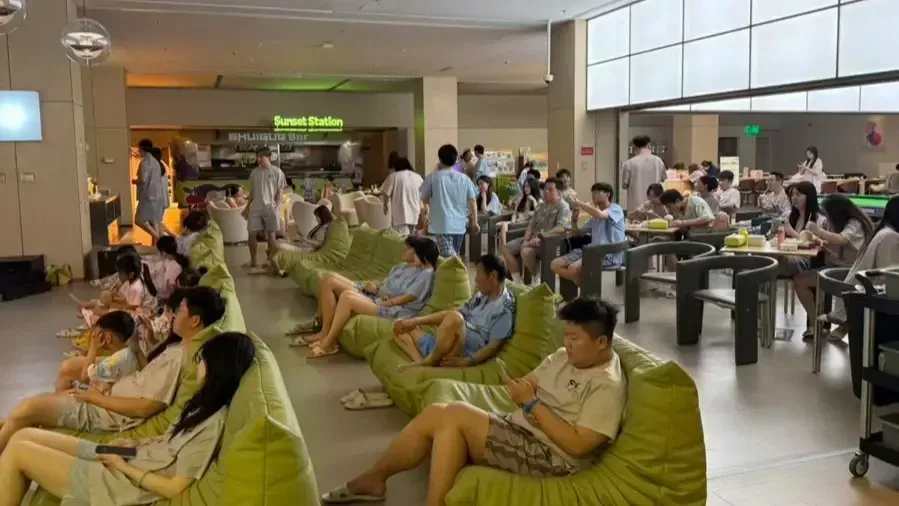
Yes, you can sleep overnight in a Shanghai bathhouse. More than a dozen of them stay open 24 hours, sell overnight tickets, and include food. Prices run from about ¥35 to ¥1,400 a head.
I want to be straight with you before the list, because every other English page treats this as a budget hotel hack.
I do not recommend sleeping overnight at one. The rest areas are open tatami platforms and recliners, not rooms. Often there is no private space, sometimes no blanket, and somebody always snores. What I actually do is lie down for a couple of hours in the evening and leave around 23:30, before the overnight crowd settles in.
The one exception is at the bottom of this page, and it is a good one.
This is the full list, not my shortlist — because this is exactly the information that is impossible to find in English. My five picks are in the Shanghai spa and bathhouse roundup. Use that page if you want me to choose. Use this one to choose yourself.
The short version
- More than a dozen venues stay open 24 hours. Prices start near ¥35 and pass ¥1,400.
- You sleep on tatami, a recliner, a beanbag or in a pod — not a bed, unless you book one of the few that also have rooms.
- “24 hours” is a ticket type. The cheap ticket may be only 8 hours at weekends.
- Bring your passport. Overnight guests must be registered after 02:00.
- Food is included at every tier. That is why even ¥300 makes financial sense.
- I would rest there for two hours, not sleep there for eight. With one exception.
The full list
List prices checked 27 September 2026. They move by channel, package and day of the week — treat every figure as “from”.
| Venue | Area | Ticket from | Sleeping setup | 24h? |
|---|---|---|---|---|
| Yunhai 云海汤泉 | Minhang, Xinzhuang | ¥34 | Basic public rest hall | Yes |
| New Sauna 纽斯桑拿 (Korean) | Pudong, Dongxiu Rd | ¥88 | Flat recliners + cinema room | Yes |
| Xiaomu 小沐汤泉 (Hongqiao) | Minhang, by Hongqiao station | ¥98 / ¥158 w. overnight | Public rest hall | Yes |
| Gokurakuyu 极乐汤 (Chuansha) | Pudong, Chuansha | ¥118 | Tatami + hotel rooms | Yes |
| Tanglilai 汤里来温泉 | Pudong, Luoshan Rd | ¥169 | Public rest hall | Yes |
| Tangliande 汤连得 (Changqing) | Pudong, Sanlin | ¥133 | Recliners + 25 guest rooms | Most branches no |
| Gokurakuyu 极乐汤 (Biyun) | Pudong, Biyun | ¥158 | Tatami + paid private rooms | To 02:00 |
| Shuiguo 水裹·汤泉 (Hongqiao) | Minhang, Hongqiao | ¥298 | Recliners, book bar, lie-flat sofas | Yes |
| Shuiguo 水裹·汤泉 (Wujiaochang) | Yangpu | ¥298 | Recliners, pods, tents | Yes |
| Young SPACE 漾·SPACE | Pudong, Pudian Rd | ¥299 | Sleep capsules + salt room | Yes |
| Yang NEO 漾·Neo | Putuo, Caoyang Rd | — | Public rest hall | Yes |
| Muyu Xinji 沐屿新集 | Hongkou | ¥599 | Quiet rooms, low lighting | Yes |
| Qianshen 浅深 (Century Park) | Pudong, Haitong Rd | ¥391 | Private rest cabins | Yes |
| Qiao Mushe 淇奥沐舍 | Pudong | ¥798 | Lounge-style daybeds | Yes |
| Qushui Lanting 曲水兰亭 | Minhang, Hongmei Rd | ¥878 | Nap rooms across several floors | Yes |
| Yashui ONSEN 亚水·ONSEN | Pudong, Chengshan Rd | ¥699 night ticket | Onsen + partitioned rest area | Yes |
The cheap end: ¥30 to ¥170
Yunhai 云海汤泉 in Xinzhuang lists around ¥34 a head, which tells you what it is. Use it if you need a shower and somewhere to sit at 3am, not if you want a night.
New Sauna 纽斯桑拿会所 (Korean) on Dongxiu Road is the standard Korean jjimjilbang. From ¥88, with fire sauna, loess clay rooms and a cinema room you can sleep in. It is busy and noisy, and it is loved.
Tanglilai 汤里来温泉 in Pudong is another 24-hour Korean-style venue with fruit included, from about ¥169 including a dining credit.
The middle: ¥160 to ¥400
Gokurakuyu 极乐汤 is the Japanese chain, and it is the one foreigners find easiest because the rules are posted in several languages. Biyun costs ¥158 in, then ¥69 for the 02:00 to 06:00 window with breakfast. Scrub is ¥68 to ¥168 on top. It shuts at 02:00, so it is the shortest night on this list rather than a full stay.
Xiaomu 小沐汤泉 sits almost on top of Hongqiao railway station, about 915m away, and rates 4.8 out of 5. It is also the clearest example of how the overnight fee works: ¥98 for the bath alone, ¥158 with the night included. Same logic as Shuiguo’s Hongqiao branch, a few hundred metres away — built for people arriving late or leaving early.
Shuiguo 水裹·汤泉 is the one most expats know. Two branches, both open 24 hours, from ¥298 with unlimited fruit, ice cream and hot food. Wujiaochang rates 4.8 out of 5 and sells a night package at about ¥347 running 21:00 to 11:00. Note the base ticket — you get 16 hours on a weekday and 8 hours at weekends for the same money.
Young SPACE 漾·SPACE in Pudong is my pick purely on sleep hardware: capsules and a salt room, 404 reviews at 4.4 out of 5, about ¥299 plus roughly ¥69 for the overnight window.
Qianshen 浅深 runs several branches including one by Century Park at about ¥391 a head, and it is one of the few mid-tier venues with genuinely private rest cabins. There is live music in the evenings, which is either the point or the problem.
Tangliande 汤连得 is Korean-style and slightly different from everything else here, because its Changqing branch has 25 actual hotel rooms rather than just rest furniture, around ¥500 to ¥800 for two including the baths. Most Tangliande branches close at 01:00 and do not take overnight guests at all, and sources disagree about which of the 24-hour branches accept overnight — check your branch directly.
The expensive end: ¥600 and up
Muyu Xinji 沐屿新集 in Hongkou, ¥599 for 24 hours. Aromatherapy, dim lighting, deliberately minimal stimulation. If your objection to all of the above is noise, this is the cheapest tier that addresses it.
Qiao Mushe 淇奥沐舍, ¥798 to ¥848 for 12 hours or ¥1,288 for 24. Piano in the evening. Feels like a members’ club more than a spa.
Qushui Lanting 曲水兰亭 is the well-known luxury answer, open 24 hours at 4.6 out of 5. I have seen it quoted at ¥878 for 12 hours, ¥1,098 for 24, and also ¥1,208 and ¥1,538 depending on package — that spread is real, so check the current ticket. Entry covers timed buffet windows and free-flow fruit. Massages, scrubs and private rooms are extra. It is 18+.
Yashui ONSEN 亚水·ONSEN in Pudong is a tier above that again: a night ticket with dinner and a scrub from ¥699, six hours from ¥998, 24 hours from ¥1,399. Reviews mention unlimited lobster, serrano ham and imported alcohol. It rates 4.8 out of 5 on only about a dozen reviews, so treat the rating as preliminary.
One thing to be clear about at this price: the ¥699 ticket buys you a partitioned rest area, not a private room. Sleeping spaces are divided areas in a shared room, the same idea as the cubbies elsewhere. If you want an actual door here, you are buying a different ticket — the tier that bundles a small private room for two starts around ¥2,299.
What “24 hours” actually buys
The entry ticket is priced by duration, not by venue. Shanghai sells 8, 12, 16 and 24-hour tickets, and the headline price is usually the shortest or the weekday version.
Shuiguo is the clearest case: the cheap ticket is 16 hours on a weekday or 8 hours at weekends, same price. Overnight is a separate, more expensive product.
Then there is the overnight fee (过夜费) itself. Some venues charge it if you are inside between 02:00 and 06:00 — about ¥69 at Gokurakuyu and Young SPACE, around ¥70 at Shuiguo per visitor accounts, and ¥60 at Xiaomu, where the ¥98 bath ticket becomes ¥158 with the night included — while others fold it into a night package.
Read the ticket name. “Night ticket plus overnight fee plus breakfast” is not the same product as “8-hour entry”.
What you actually sleep on
Four setups, and the difference between them is the whole experience.
Open tatami or a recliner in the shared lounge. Most common, and usually what you get at the cheap end. Recliners or mats on a raised platform, one shared space, other people.
Capsule pods or honeycomb cubbies (格子间). A walled box with a mat. Shuiguo’s reportedly come with an eye mask and earplugs, and Young SPACE is built around them. Best of the no-room options, and they run out first.
Small tents or beds. Some venues scatter single-occupant tents through the lounge. No door.
An actual room. Rare, and worth knowing about: Tangliande Changqing (around ¥500–800 for two), Yashui ONSEN on its higher ticket tiers, and Gokurakuyu Chuansha. If having a door is non-negotiable, book one of these instead of pretending a recliner will do.
Two honest details that the budget-hotel framing usually skips. Not every place gives you a blanket — ask at reception when you check in, and take a long-sleeve layer regardless, because the dry areas are air conditioned hard. And the family-friendly venues have children, which is lovely at 19:00 and not at 03:00.
The passport rule nobody mentions
Shanghai’s accommodation registration rules define a 留宿过夜浴场(室) — a bathhouse that takes overnight guests — as a licensed accommodation unit. Anyone still inside after 02:00, or entering between 02:00 and 08:00, has to be registered against a valid ID, uploaded within two hours (Shanghai Municipal Government, 沪公行规〔2025〕6号, in force since 28 April 2025).
Foreign visitors, and Hong Kong, Macao and Taiwan residents, register on a passport or travel document instead. So:
- Carry the physical passport. Not a photo of it.
- A venue that waves you through without registration is not being easygoing — it is cutting a corner that is also your quality signal. The same regulation requires the special trade licence.
- Arrive before 01:00. Registration takes a few minutes and night reception is thin.
Why I wouldn’t actually sleep there
This is my own view, and it is the opposite of what the ¥300-versus-a-hotel arithmetic suggests.
Every time I have spent an evening in one of these places, I have lain down for two hours or so — arriving around 21:00, out by about 23:30 — and then gone home. That is the version I recommend, and it is genuinely lovely. You get a soak, dinner, a film and a nap for a fair price.
What I would not do is stay. The reasons are boring and physical:
- The rest area is one shared open space. You are in house pyjamas on a platform with strangers.
- It is noisy. People talk, doors open, somebody always snores.
- Sometimes there is no blanket, or not enough of them.
- You cannot lock anything away beyond your clothes locker, so you sleep with your valuables or you do not sleep.
- You will not get a proper night. If tomorrow involves a meeting or a full day of walking, this is a bad trade for ¥200 saved.
Hygiene is worth one sentence too. Shower thoroughly before you get in and again after you get out, because not everyone does. If you have an open cut or a fresh scrape, sit out the communal pools.
The one case where I would
Pudong, after Disneyland, with an early flight the next morning.
This is exactly the Japanese airport-onsen logic. Disney closes late, you are exhausted, the hotel you are not returning to is an hour away across the city, and your flight leaves before the metro starts. A soak at midnight, a few hours horizontal, and a 6am departure that costs a fraction of an airport hotel.
The venue for it is Gokurakuyu’s Chuansha branch (极乐汤川沙店), and it is better suited to this than a normal bathhouse, because it is not only a bathhouse:
- It runs 24 hours, which is the whole point for an early flight.
- It is genuinely close to Disneyland — reviewers mention it constantly, and it is the reason the branch exists.
- It runs free shuttle buses to Disneyland and to Pudong airport, plus free parking. Confirm the timetable when you book, because these change.
- It is also a hotel. This is the important bit: instead of sleeping on a tatami platform in a shared room, you can book an actual room and still use the baths. That removes every objection in the section above. Its hotel listing carries 4,574 reviews at 9.2 out of 10, and reviewers describe exactly this use case — arriving late, transferring between flights, needing one night near the airport.
One caution on the room itself: check whether the room type you book has a private bathroom. One reviewer booked a cheap double and found it did not, though staff upgraded them for free.
Branch details move — opening hours, shuttle timetables and which tickets include the overnight window all change, so verify before planning a night around it.
How to rest there without staying
The version I actually recommend, and it works at most venues on this list.
- Arrive 20:00–21:00. Enough time for the wet area before it gets busy, and you get first pick of the good rest spots.
- Soak first, eat second. The food is a real part of the value, so turn up hungry rather than full.
- Claim your spot before 22:00. Pods and tents go first.
- Lie down for an hour or two. This is the good part.
- Leave around 23:30. The last metro is roughly 23:00, so plan a taxi, or move on before you are locked into the overnight window and its registration.
You get most of the experience, none of the 3am regrets, and you sleep in your own bed.