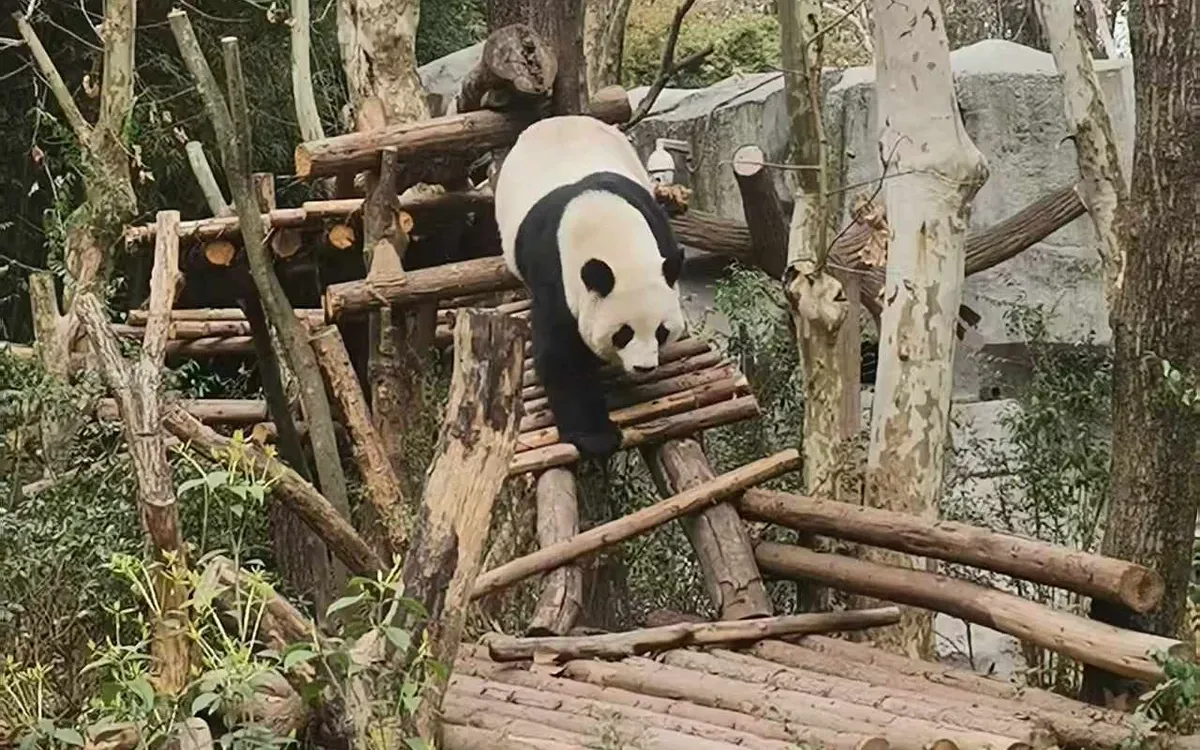
Search for Chengdu pandas and you will be sold a ticket. The guides that come up are mostly booking pages with a few paragraphs attached, and they nearly all describe the same place in the same order: tickets, best time, how to get there, a walking route.
The question they answer least well is the one you actually arrive with. Not how to buy the ticket, but which panda place you want, and what kind of place it is when you walk through the gate.
There are two realistic answers, and they are not interchangeable. The Chengdu Research Base of Giant Panda Breeding sits inside the city, about 10 km from Tianfu Square, with a metro line running to it.
Panda Valley is the other one: the base’s own field research centre near Dujiangyan, roughly 50 km out, set in a wooded valley with a single loop route.
I have been to the Chengdu Panda Base. I have not been to Panda Valley; that part of this guide mixes the official pages with a friend’s repeated visits there, and I mark where her experience ends and my research begins.
The short answer
| What you want | I would go to | Why |
|---|---|---|
| One easy, high-density panda morning | Chengdu Panda Base | One metro line, two gates, the most animals in one place. |
| A quieter, greener half-day that is easy on the legs | Panda Valley | One gentle loop, 2-3 hours, shade and streams. |
| A panda day that also fits Dujiangyan | Panda Valley | It sits about 3 km from Dujiangyan town. |
| A mountain day with a panda kindergarten | Wolong Shenshuping | About 100 km out, so it is a full day. |
| Pandas inside a scenic canyon | Bifengxia, Ya’an | Around 160 km, sold with the scenic area ticket. |
You are not choosing between a good option and a bad one. You are choosing between a campus with a big breeding population in one place, and a valley with a shorter, calmer route.
My answer is the main base. It is crowded and the walking is not easy, but if you are only coming once, it is the right one.
What the Chengdu Panda Base actually is
It is not a zoo, and its own description does not pretend otherwise. The institution calls itself an ex-situ conservation base, a scientific breeding base, a popular-science education base and a cultural tourism base, in that order.
It was founded in March 1987, and the origin story is specific. In the 1980s, the arrow bamboo in the Qionglai mountains flowered and died off over a wide area, and pandas were brought in for emergency rescue.
The base started with six pandas rescued from the wild. Every panda there today comes from those six.
By the end of 2025 the base reported more than 270 giant pandas, the world’s largest captive breeding population. It also holds the world’s largest captive red panda population, 201 animals at the end of 2025.
The red panda figure is the one I would plan around. In early 2026 the base opened a hillside red panda enclosure covering 12,000 square metres, split into four separate activity areas, with the first 22 animals moved in that January.
That matters because most visitors arrive looking only for the black-and-white animal. The red pandas are a separate species, and they are often more active than the giant pandas.
That matters for how you plan. Animals go indoors in heat, and cubs only appear in some seasons. If you only want to see one famous panda, you may spend the morning in a queue.
I have been there myself, and I would go again without hesitating. What I did not expect was how much there is beyond the famous pandas: the red pandas, the quieter enclosures, the areas where you can watch staff work.
Even the friends of mine who do not plan trips around animals had a good morning there.
Panda Base, Panda Valley, or somewhere else
| Chengdu Panda Base | Panda Valley | Wolong Shenshuping | Bifengxia, Ya’an | |
|---|---|---|---|---|
| What it is | Main city campus | Field research centre for pre-release training | Reserve base with a panda kindergarten | Conservation centre inside a canyon scenic area |
| Distance from Chengdu | About 10 km | About 50 km | About 100 km | About 160 km |
| Adult ticket | ¥55 | ¥55 | About ¥85 | Around ¥95-100 with the scenic area |
| Booking window | 14 days | 7 days | Varies by channel | Varies by channel |
| Reached by | Metro Line 3 plus a shuttle bus | Train to Dujiangyan then a taxi, or a car | Car, realistically | Train to Ya’an then a shuttle |
| Best for | First-timers, the fullest panda day | Families, older visitors, a low-effort loop | A full day for keen panda people | Hiking plus pandas |
The main base and Panda Valley cost the same. Wolong and Bifengxia are not really competitors. They are day trips in their own right, so I would treat them as a separate choice: how much of your Chengdu time do you want to spend on the road?
What Panda Valley is actually like to walk
I have not walked it myself, so this is my friend’s account, from visits there with small children.
The route is a single loop, and you basically cannot get it wrong. Her family covers the whole circle in two to three hours without a plan, on gentle slopes, under tree cover, past streams and small waterfalls in the valley.
You also get closer to the animals than you do at the city base, and there is far less walking to see them.
That is the honest trade. The main base gives you far more, and asks more of your legs to see it. Panda Valley gives you a shorter, shadier, gentler circuit, and costs you the trip out of the city.
There are two panda places near Dujiangyan
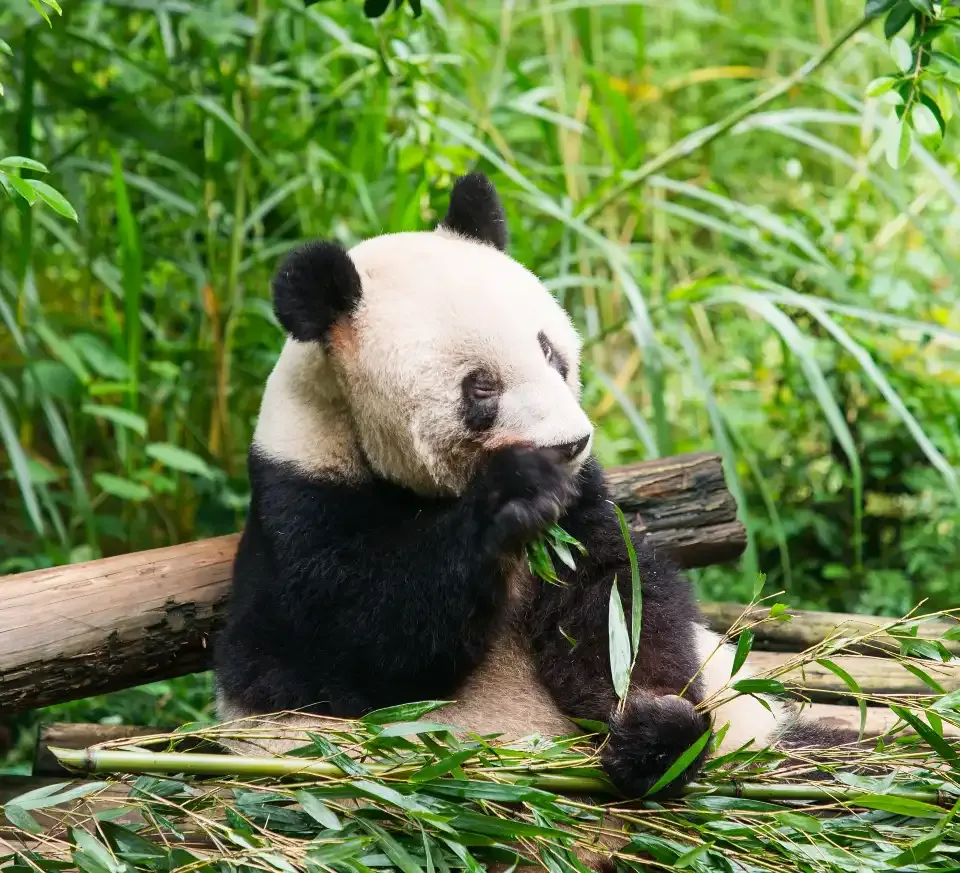
This is the mix-up that costs people money. Panda Valley is the Chengdu Research Base’s own field centre, and it is open.
The other one, the Dujiangyan China Giant Panda Garden, belongs to a different institution, the China Conservation and Research Centre for the Giant Panda. It has been closed for renovation since 23 April 2026, with reopening to be announced separately.
If a booking page or a transfer product says only “Dujiangyan panda base,” check which institution it means before you pay. The facilities sit in the same region and the names are close enough that Chinese travel sites still list them side by side.
Tickets and booking
Prices below were checked on the Chengdu base’s official English ticket page on 17 October 2026.
| Ticket | Price | Who |
|---|---|---|
| Adult | ¥55 | Ages 18 to 59 |
| Student | ¥27 | Undergraduate students and below, not adult education |
| Senior | Free, no reservation needed | 60 and over |
| Child | Free, no reservation needed | Under 6, or under 1.3 m |
| Annual pass | ¥168 | Ages 7 to 59, Chengdu base only |
Two rules do most of the work. First, tickets are sold in morning or afternoon sessions, and you enter only in the session you booked. Second, entry is real-name, one ticket per person per ID document.
The base also caps daily visitors at 85,000. The number sounds enormous, and it still sells out on holidays.
Booking through the WeChat mini program
I have not watched a foreign visitor do this, so this is the official route, not a field report.
- Open WeChat and search for the official Chengdu Research Base of Giant Panda Breeding mini program.
- Choose a date and a session. Tickets open 14 days ahead.
- Enter the visitor’s name and ID number exactly as it appears on the document. For most foreign visitors that is the passport number.
- Pay. WeChat Pay now works with many foreign cards, but setting that up is a separate job.
- At the gate, use the lane for visitors with original documents if you have the passport with you, or the lane for a photo of it if you do not.
The base lists its authorised channels itself: its own WeChat account and mini program, plus Meituan, Trip.com, Douyin, Tongcheng and the Chengdu Scenic Shuttle Bus account.
Booking through Trip.com is legitimate, because the base names it. Klook is not on that list. A Klook or GetYourGuide panda product is therefore a tour, a transfer or a bundle, not a plain ticket. Ask what it includes and whether it guarantees your session.
For most independent travellers I would book directly or through Trip.com and skip the rest. The mini program is the cheapest route, but it assumes you have WeChat set up and a way to pay.
If it looks sold out
The morning session goes first. If your date is gone, the fallback order I would use is: try the afternoon session, then shift the day, then look at Panda Valley, which caps visitors far lower than the city base does.
The official notice says that if you genuinely cannot pay online, you may buy at the on-site windows if tickets remain. That is a real door, not a promise.
Best time and how to plan the visit
Entry hours change with the season. From March to October the morning session runs 7:30 to 12:00 and the afternoon session 12:00 to 17:00, with the park cleared at 18:00. From November to February, morning entry is 8:00 to 12:00, afternoon entry 12:00 to 16:30, and clearing starts at 17:30.
Book the morning session and arrive when it opens. Pandas are most active in the cool part of the day and around feeding. By the afternoon, in the warmer months especially, a lot of the animals will be indoors or asleep, and you will be looking at bamboo.
If you only follow one tip, make it this one. It matters more than which gate you pick.
Rain is less of a problem than you would think, since it cools the air and thins the crowds, but the site is hilly and the paths get wet.
Avoid the first week of October and Chinese New Year if you can. These are the two periods when 85,000 daily tickets become an actual constraint.
Plan for 3-4 hours. It is a large site with slopes, and the enclosures are spread out rather than lined up. Sightseeing vehicles run inside, and I would use them if anyone in your group walks slowly.
Getting there
Take Metro Line 3 to Panda Avenue Station, leave by Exit A, and pick up shuttle bus 408 to the South Gate. From Zoo Station, buses 655 and 87 also run to the South Gate.
For the West Gate, take Line 3 to Junqu General Hospital Station, leave by Exit B, and transfer to shuttle bus 409, which the base says takes about 10 minutes. Buses 110, 110A and 659 stop at Yulei Road Cuiwei Intersection, a 600-metre walk from the gate.
Official taxi reference fares from the base’s own page: about ¥40 from the Chunxi Road area in 25-35 minutes, about ¥40 from Chengdu East Railway Station, about ¥100 from Shuangliu International Airport in 40-50 minutes, and about ¥200 from Tianfu International Airport in 60-70 minutes.
There are also direct tourist coaches from Chunxi Road and Kuanzhai Alley, which saves the interchange if you are starting there.
On gates, the one useful difference is crowding. The South Gate is the traditional main entrance and the one the 408 shuttle serves. The West Gate is newer and generally less busy. If you are arriving at opening time on a weekend, entering at the West Gate is the calmer start.
What you will see
Adult pandas in their own enclosures, and the nursery areas where cubs are kept when there are any. Cubs are seasonal, so no plan should assume them.
Then the red pandas. The hillside red panda area is the newer part, and it is the part I would make a point of finding.
There is a Giant Panda Museum on site. It is an easy indoor hour if the weather turns or if the animals have all gone to sleep, and it is where the research story is actually spelled out.
Remember it is a working facility. If keepers are moving an animal or an enclosure is closed for cleaning, that is normal. The pandas here are part of a managed breeding programme, not a wildlife sighting.
One thing to be clear about: the base runs a science education volunteer programme and recruits for it seasonally. It is meant for people who live locally, not for visitors, and there was an autumn 2026 recruitment notice on its news page. I would not build a trip around it.
Here is my honest version, from my own visit. It is busy, the site is big, and the route is more complicated than a simple loop, because different enclosures hold different animals. People queue for the celebrity pandas, Hua Hua among them. The walking is not easy, and I still think it is worth it.
Where to eat and what to combine it with
Food inside a panda base is convenience food. I would eat before you go or after you come out, and treat the base as a morning.
For where to stay, two options make sense. Near Chunxi Road or Taikoo Li if you want to be able to walk to dinner and reach Metro Line 3 easily, or around Chengdu East Railway Station if you are arriving by high-speed train and leaving that way too.
The natural pairing for a panda morning is a Chengdu afternoon, not another panda. If you want the second panda experience, give Panda Valley its own day and put Dujiangyan or Mount Qingcheng alongside it rather than trying to stack it onto the city morning.
My take
I have already taken the side. If you are only in Chengdu once, go to the main base. Go at opening time, accept the crowds, and give the red pandas their share of your time.
I have enjoyed it even on the days when the walking got long. Use the sightseeing vehicle if anyone’s legs need it.
Panda Valley is the day I would give to families, or to anyone who has already done the city base and wants a slower second panda morning. It is not the lesser option. It is the easier one, and the valley setting does a lot of the work for you.
What I would not do is treat these as a ranking. They are different institutions doing different jobs, one holding a breeding population where people can reach it, one training animals for release.
Which one you should visit depends on the day you have and who you are travelling with, not on which name sounds better in an itinerary.
Before you book anything, check the Chengdu destination page for the wider trip, and read the base’s own English ticket page on the day you book, because the session rules are the thing that changes.